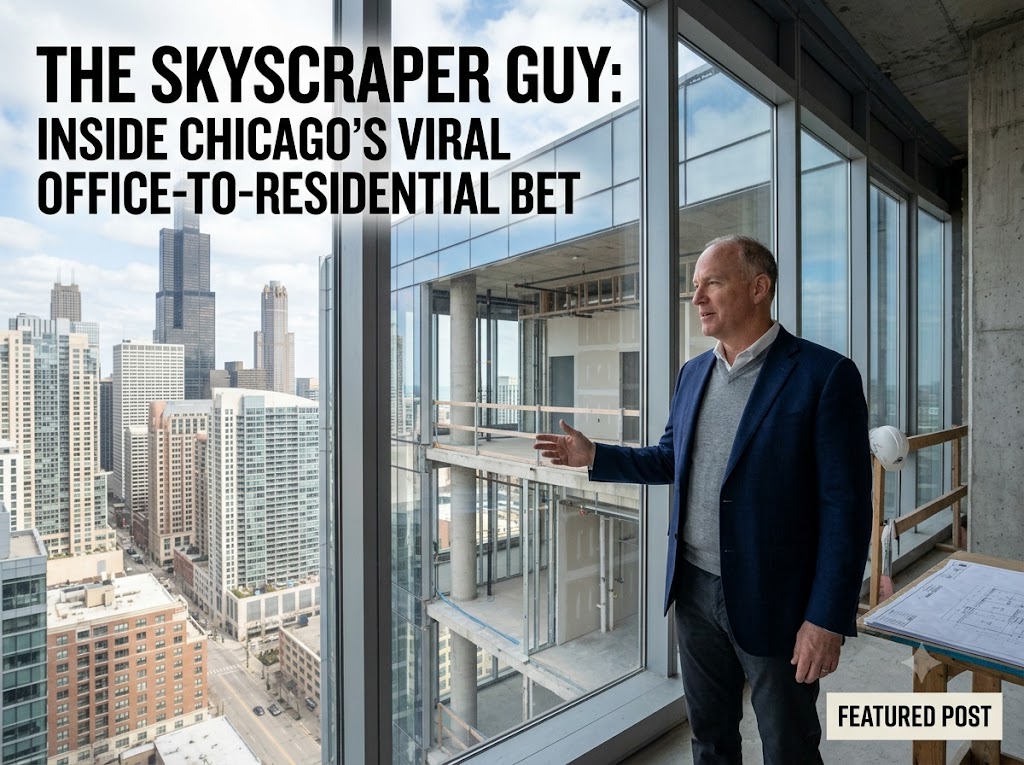
A century-old Chicago tower just became one of the most-watched real estate stories on TikTok. Real estate investor Tom Liravongsa bought 30 of the 40 floors inside the Pittsfield Building, a 1927 skyscraper in the East Loop, and has spent months documenting the renovation for millions of viewers. What started as viral content has turned into a real case study in how developers are converting aging office towers into housing.
Table of Contents
- What Is the Pittsfield Building
- How Tom Liravongsa Turned a Skyscraper Purchase Into a TikTok Phenomenon
- Why Investors Are Converting Old Office Towers Into Housing
- What the Pittsfield Building Says About the Office Conversion Boom
- Key Takeaways
- FAQ
What Is the Pittsfield Building
The Pittsfield Building is a 38-story tower at 55 East Washington Street in downtown Chicago, designed by the firm Graham, Anderson, Probst & White and completed in 1927. It was Chicago’s tallest building at the time it opened and was designated a Chicago Landmark in 2002. The tower spent decades as commercial office space before real estate investor Tom Liravongsa purchased 30 of its 40 floors and began converting most of the space into residential units.
How Tom Liravongsa Turned a Skyscraper Purchase Into a TikTok Phenomenon
Liravongsa is the founder and CEO of L’Cre Global, a Grand Rapids, Michigan investment firm focused on real estate and alternative assets. He began posting videos of his skyscraper renovations in late 2023, but the Pittsfield Building purchase turned his account, known online as The Skyscraper Guy, into a viral sensation. One video documenting hidden rooms and forgotten spaces inside the tower drew more than 2.4 million views within a week of posting.
Liravongsa says his account gained 250,000 followers and 30 million views in the first five days after the Pittsfield videos went up. His content has shown viewers a Prohibition-era speakeasy, a hand-carved copper ceiling, a bronze elevator dial, and a safe with no known combination, all discovered inside a single building that most Chicagoans walk past without a second glance.
Why Investors Are Converting Old Office Towers Into Housing
Renovating a floor inside a century-old high-rise is not cheap. Liravongsa has said demolition alone runs upward of $200,000 per floor before any residential buildout begins. Crews working on the Pittsfield Building have found tunnel entrances roughly 150 feet underground and walked fire escapes 250 feet above the street, a reminder of how much unknown infrastructure sits inside pre-war towers.
The economics still work because aging office towers in cities like Chicago often trade at a steep discount to their replacement cost, while demand for downtown apartments has stayed resilient. Converting a landmark building into residential units also qualifies for historic tax credits in many cities, an incentive that has pushed other developers toward similar office-to-residential deals nationwide.
What the Pittsfield Building Says About the Office Conversion Boom
Downtown Chicago has one of the highest office vacancy rates of any major US market, which is exactly why investors like Liravongsa see opportunity in buildings that once housed law firms and insurance brokers. The Pittsfield deal, first reported by Crain’s Chicago Business as the building changed hands during a court battle, is a small but visible piece of a much larger national trend converting outdated office stock into apartments.
That trend is playing out alongside record momentum elsewhere in commercial real estate, from the office towers rising in San Francisco to the record breaking AI data center construction boom reshaping American skylines in 2026.
Key Takeaways
- Tom Liravongsa purchased 30 of the 40 floors inside Chicago’s Pittsfield Building, a 38-story tower built in 1927
- His renovation videos have generated more than 30 million views and 250,000 new followers in five days
- Floor demolition alone costs upward of $200,000 as crews uncover tunnels, hidden rooms, and century-old architectural details
- The building is being converted primarily into residential units, part of a broader office-to-residential trend in downtown Chicago
- Historic tax credits and steep office valuation discounts are driving similar conversions in cities nationwide
FAQ
Who is the Skyscraper Guy on TikTok
The Skyscraper Guy is Tom Liravongsa, founder and CEO of L’Cre Global, a Grand Rapids, Michigan real estate investment firm. He documents his renovations of century-old office towers, including Chicago’s Pittsfield Building, for millions of TikTok followers.
What is the Pittsfield Building
The Pittsfield Building is a 38-story tower at 55 East Washington Street in downtown Chicago, completed in 1927 and designed by Graham, Anderson, Probst & White. It was designated a Chicago Landmark in 2002.
How many floors did Tom Liravongsa buy
Liravongsa purchased 30 of the Pittsfield Building’s 40 floors, with plans to convert most of that space into residential units.
How much does it cost to renovate a skyscraper floor
Demolition alone can run upward of $200,000 per floor in a pre-war high-rise, before any residential buildout, plumbing, or electrical work begins.
Why are old office buildings being converted into apartments
Aging office towers often trade far below their replacement cost while downtown apartment demand stays strong, and historic tax credits can offset renovation costs, making office-to-residential conversions financially attractive.
Has anyone else gone viral for buying a skyscraper
Liravongsa’s account is the most prominent example, but his success has encouraged other real estate investors to document large commercial acquisitions online as a way to build an audience and attract future investment partners.
The Pittsfield Building is proof that America’s office towers still have a second act. Follow Estate Innovation for continuing coverage of the commercial real estate stories reshaping US cities in 2026.
What This Means for Real Estate Investors and Developers
The Chicago office to residential conversion model is being studied by developers across the US. Cities including New York, San Francisco, Washington DC, and Dallas are all at various stages of incentive programs designed to replicate what Chicago has achieved. For investors, the opportunity lies in identifying undervalued commercial assets in cities with comparable zoning flexibility and housing demand gaps.
The key financial metric in office to residential conversion is the cost per door. In Chicago, costs have ranged from $180,000 to $320,000 per unit depending on the building’s existing infrastructure, floor plate configuration, and mechanical systems. Buildings with smaller floor plates convert more efficiently because natural light penetration is less of an engineering challenge. The Skyscraper Guy’s projects have benefited from existing elevator banks, lobbies, and structural systems that reduce the civil engineering cost component significantly.
Internal Resources on Commercial Real Estate and Construction
- Commercial Real Estate Insights covering investment trends, office market data, and development opportunities
- Construction Industry Updates tracking costs, materials, and project pipelines across major US markets
- Luxury Vinyl Plank Flooring Guide covering the flooring material most commonly specified in residential conversion projects
External Sources and Further Reading
- Urban Land Institute publishes the most comprehensive research on office to residential conversion viability by city and building type
- CoStar Group tracks commercial real estate transactions and conversion project pipelines in real time across all major US markets
- National Association of Home Builders provides data on residential conversion costs and regulatory requirements by state
Speak to Our Real Estate Development Specialists
Estate Innovation works with developers, investors, and property owners navigating commercial to residential conversion projects across the US. Whether you are evaluating a building’s conversion potential, sourcing financing, or planning a phased development strategy, our team provides actionable guidance grounded in current market data.
Contact Estate Innovation today to discuss your project. Our specialists have hands on experience with adaptive reuse projects in major US markets and can provide a no obligation assessment of your building’s residential conversion opportunity.