What Is Bubble Palace?
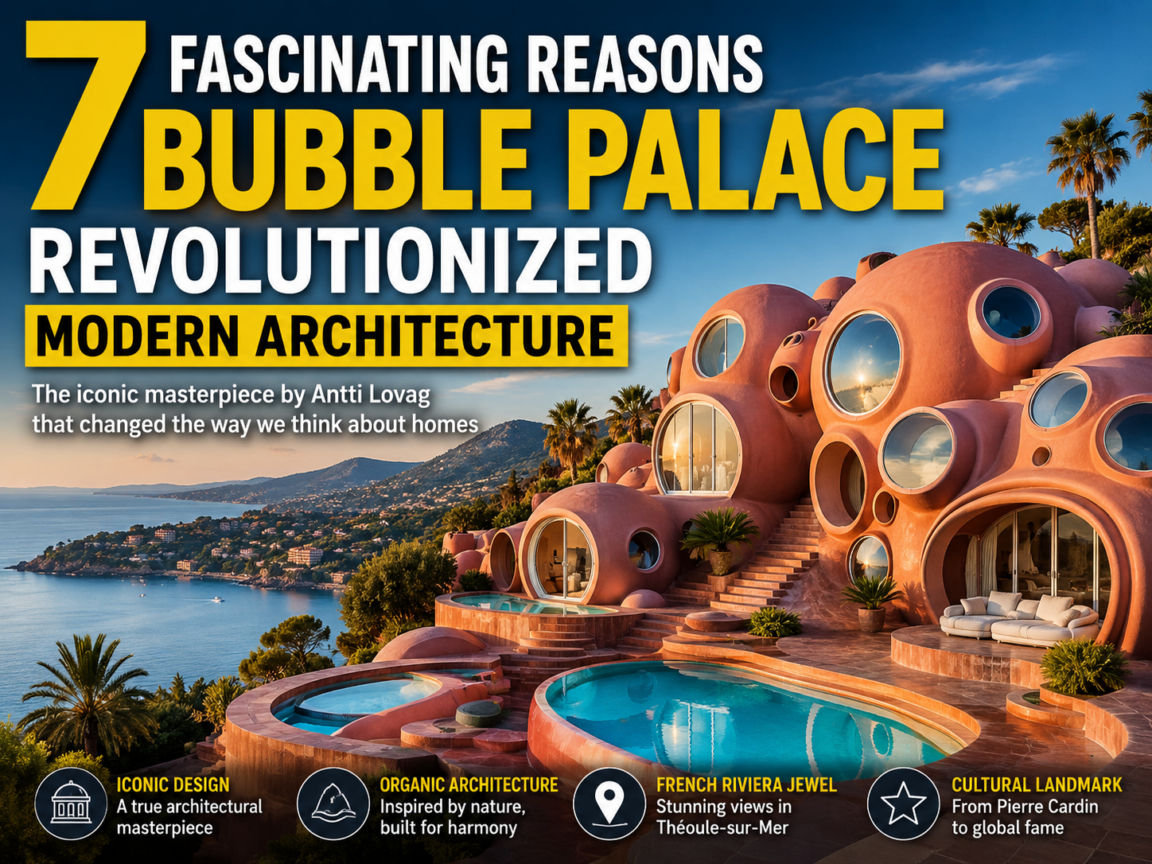
Bubble Palace is one of the most extraordinary private residences ever built. Perched on the hills of Théoule-sur-Mer overlooking the Mediterranean Sea near Cannes, France, the property stands apart from nearly every luxury home in the world. While most mansions rely on symmetry, straight walls, and conventional room layouts, Bubble Palace embraces curves, circular forms, and interconnected spaces inspired by nature.
The residence resembles a collection of giant bubbles emerging from the landscape. Its unusual appearance has made it one of the most photographed architectural landmarks on the French Riviera. Yet Bubble Palace is more than a visual spectacle. It represents a radical architectural philosophy that challenged traditional ideas about how people should live and interact with their surroundings.
For architects and design enthusiasts, Bubble Palace remains a powerful example of how innovation can transform residential architecture.
Who Designed Bubble Palace?
The creative force behind Bubble Palace was Hungarian-born architect Antti Lovag. Unlike many architects of his era, Lovag questioned the dominance of rectangular buildings and straight lines in modern construction.
He believed that architecture should adapt to human behavior rather than force people to conform to rigid structures. According to Lovag, traditional homes often ignored the natural ways people move, interact, and experience space. He viewed straight lines as artificial elements rarely found in nature.
Instead, Lovag favored organic forms inspired by caves, shells, hillsides, and the human body itself. His architectural philosophy focused on creating environments that felt intuitive, comfortable, and connected to the surrounding landscape.
Bubble Palace became the ultimate expression of these ideas.
Why Was Bubble Palace Built?
The story of Bubble Palace began in the 1970s when French industrialist Pierre Bernard commissioned Antti Lovag to design a unique residence on the French Riviera.
Rather than requesting a traditional luxury villa, Bernard embraced Lovag’s experimental vision. Together, they set out to create a home that would challenge conventional architectural standards and explore entirely new possibilities for residential living.
Construction was a lengthy and complex process that took more than a decade to complete. The unusual shapes required innovative building techniques and extensive customization. Every curved surface, circular opening, and interconnected dome had to be carefully designed and constructed.
The result was not simply a residence but an architectural statement. Bubble Palace demonstrated that homes could be designed around human movement, environmental integration, and artistic expression rather than conventional geometry.
Why Does Bubble Palace Have No Straight Lines?
One of the most fascinating aspects of Bubble Palace is its complete rejection of straight lines.
For Antti Lovag, this decision was based on more than aesthetics. He believed that straight lines were an artificial invention that did not reflect the natural world. Nature is filled with curves, whether in coastlines, mountains, caves, plants, or the human body.
Lovag argued that people instinctively respond to organic shapes because they mirror the environments humans have evolved within for thousands of years. By removing sharp corners and rigid layouts, he hoped to create spaces that felt more natural and comfortable.
Every room in Bubble Palace follows this philosophy. Walls curve gently into ceilings. Circular windows frame views of the Mediterranean. Pathways flow naturally between living areas without abrupt transitions.
The result is a residence that feels more like a living organism than a conventional building.
The Unique Features of Bubble Palace
Several features distinguish Bubble Palace from traditional luxury estates.
The property consists of multiple interconnected spherical structures that blend into the surrounding hillside. Rather than imposing itself on the landscape, the home appears to emerge naturally from it.
Among its most notable features are:
Panoramic Mediterranean Views
Large circular windows provide sweeping views of the Mediterranean Sea. The positioning of these openings was carefully planned to maximize natural light while creating a constant visual connection between the interior and the surrounding environment.
Ten Distinctive Bedrooms
Each bedroom features unique proportions, shapes, and design elements. No two spaces feel identical, reinforcing Lovag’s belief that architecture should provide varied and personalized experiences.
Three Swimming Pools
The residence includes multiple swimming pools integrated into the organic layout of the property. Their curved forms complement the overall architectural language of the home.
Open-Air Amphitheater
One of the most impressive features of Bubble Palace is its 500-seat outdoor amphitheater. This space was designed for performances, gatherings, and cultural events while taking advantage of the stunning coastal setting.
Integrated Landscaping
Unlike many luxury homes that separate architecture from nature, Bubble Palace merges the two. Terraces, gardens, and pathways flow seamlessly around the curved structures, creating a unified environment.
How Pierre Cardin Helped Make Bubble Palace Famous
Although Bubble Palace was already an architectural marvel, its global profile increased dramatically when renowned fashion designer Pierre Cardin acquired the property in the early 1990s.
Cardin was known for embracing futuristic design across multiple creative disciplines. Bubble Palace aligned perfectly with his vision and aesthetic preferences.
Under Cardin’s ownership, the residence became a venue for fashion events, exhibitions, artistic gatherings, and cultural celebrations. These activities introduced Bubble Palace to international audiences and helped establish it as one of the most recognizable private residences in the world.
Photographs of the home appeared in magazines, architectural publications, and media outlets worldwide. As a result, Bubble Palace became synonymous with innovation, creativity, and unconventional luxury.
Why Bubble Palace Matters in Architectural History
The significance of Bubble Palace extends far beyond its appearance.
The project challenged architects to reconsider long-standing assumptions about residential design. It demonstrated that homes do not need to follow traditional formulas to be functional, comfortable, or visually appealing.
Bubble Palace also contributed to broader discussions about organic architecture, a movement that seeks harmony between buildings, people, and nature. Similar principles can be seen in the work of pioneering architects who emphasized natural forms and human-centered design.
Today, many architects continue to explore concepts that Bubble Palace helped popularize, including biomimicry, sustainable integration with landscapes, and flexible spatial planning.
Its influence can be found in experimental homes, cultural buildings, and contemporary architectural projects around the world.
Lessons Modern Architects Can Learn From Bubble Palace
Despite being decades old, Bubble Palace remains remarkably relevant.
Modern architects can draw several valuable lessons from the project:
- Design should prioritize human experience.
- Architecture can challenge established conventions.
- Natural forms often create more engaging environments.
- Buildings should respond to their surroundings rather than dominate them.
- Creativity and functionality can coexist successfully.
These principles continue to guide innovative architectural projects today.
Why Bubble Palace Continues to Inspire Designers
In an era when many luxury developments look increasingly similar, Bubble Palace serves as a reminder that architecture can still be bold, experimental, and deeply personal.
Its organic forms, unconventional layout, and visionary philosophy continue to attract architects, students, and design enthusiasts from around the world. Visitors and observers are often struck by how contemporary the residence still feels despite being conceived decades ago.
Few homes have challenged architectural norms as successfully or as memorably as Bubble Palace.
Bubble Palace is far more than a luxury residence on the French Riviera. It is a landmark of architectural innovation and a testament to Antti Lovag’s belief that buildings should adapt to people rather than the other way around.
By eliminating straight lines, embracing organic forms, and designing spaces inspired by nature, Lovag created a home that continues to influence architecture worldwide. Decades after its completion, Bubble Palace remains one of the most important examples of experimental residential design ever constructed.
Its enduring legacy proves that the most influential architectural ideas often come from those willing to question the rules and imagine something entirely new.
Explore More Architectural Innovations
Bubble Palace proves that great architecture is not about following established rules. It is about reimagining how people experience space.
If you’re passionate about groundbreaking architecture, sustainable design, and the future of real estate innovation, explore more stories on Estate Innovation. From visionary residential projects to emerging architectural technologies, we cover the ideas shaping tomorrow’s built environment.