



Saudi Arabia’s Architectural Revolution
Saudi Arabia skyscrapers are reshaping the global architectural landscape in 2026. From the breathtaking Jeddah Tower to the spiritual magnificence of the Makkah Royal Clock Tower, the Kingdom is executing one of the most ambitious vertical construction programs in modern history.
Table of Contents
The tallest buildings 2026 in Saudi Arabia represent far more than architectural ambitionthey symbolize national vision, economic power, and infrastructure designed to serve generations. As of February 2026, Saudi Arabia stands at the forefront of global supertall development, with multiple world-record-setting structures either completed or under active construction.
This comprehensive guide explores the top 10 tallest buildings in Saudi Arabia, their construction timelines, technological innovations, and strategic importance to Vision 2030 and beyond.
Saudi Arabia’s Tallest Buildings Ranked (2026)
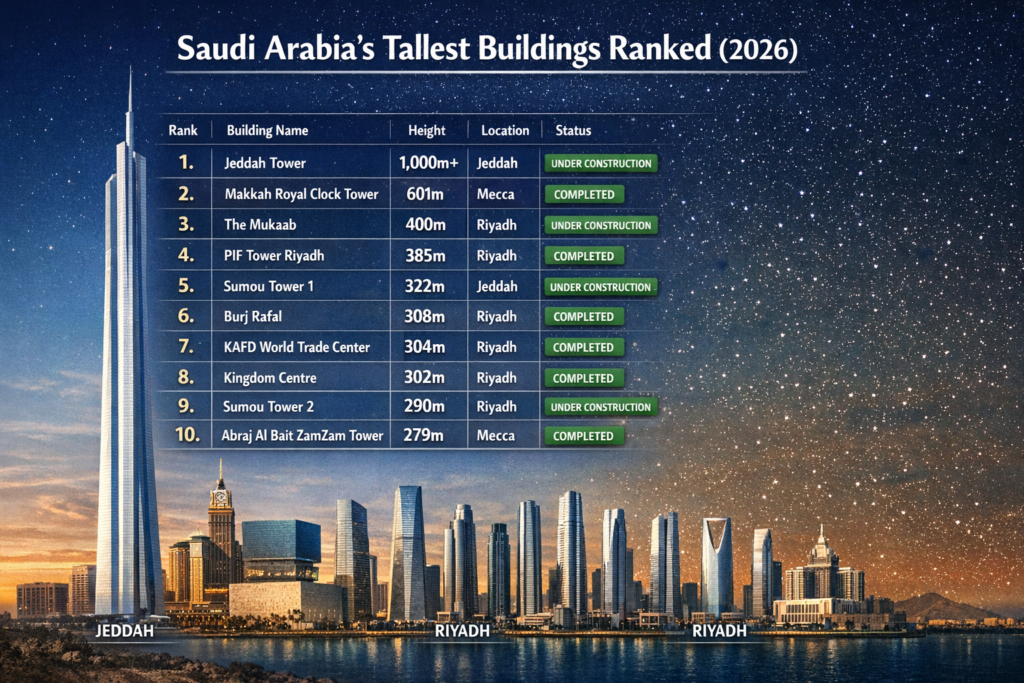
| Rank | Building Name | Height | Location | Status |
|---|---|---|---|---|
| 1 | Jeddah Tower | 1,000m+ | Jeddah | Under Construction |
| 2 | Makkah Royal Clock Tower | 601m | Mecca | Completed |
| 3 | The Mukaab | 400m | Riyadh | Under Construction |
| 4 | PIF Tower Riyadh | 385m | Riyadh | Completed |
| 5 | Sumou Tower 1 | 322m | Jeddah | Under Construction |
| 6 | Burj Rafal | 308m | Riyadh | Completed |
| 7 | KAFD World Trade Center | 304m | Riyadh | Completed |
| 8 | Kingdom Centre | 302m | Riyadh | Completed |
| 9 | Sumou Tower 2 | 290m | Jeddah | Under Construction |
| 10 | Abraj Al Bait ZamZam Tower | 279m | Mecca | Completed |
1. Jeddah Tower: Engineering the World’s Tallest Building
Overview
The Jeddah Tower stands as the crown jewel of Saudi Arabia’s architectural ambitions. Once completed, this revolutionary structure will exceed 1,000 meters in height, surpassing the Burj Khalifa and claiming the title of the world’s tallest building ever constructed by humanity.
Construction Timeline
Start Date: April 1, 2013
Development Halt: Structural work paused in 2018 due to contractor and economic issues
Resumption: January 2025 with renewed contracts
Current Status (2026): Under construction with more than 80 floors complete (≈50% structural work)
Targeted Completion: 2028
Engineering & Design Features
The Jeddah Tower is engineered with a high-performance reinforced concrete core and advanced wind-resistant structural systems designed to withstand Red Sea wind patterns and extreme vertical stress. Over 15,000 workers have been involved across various construction phases.
Investment: Exceeds $20 billion when accounting for surrounding urban development
Purpose: Mixed-use development including:
- Luxury residences
- Five-star hotel
- Corporate offices
- Observation decks
- Vertical infrastructure systems
Strategic Importance
The Jeddah Tower is a multi-generational landmark engineered to stand for over a century, positioning Saudi Arabia permanently at the center of global architecture and attracting international tourism and investment.
2. Makkah Royal Clock Tower: Faith & Scale
Overview
Standing at 601 meters, the Makkah Royal Clock Tower remains the tallest completed building in the Kingdom. As part of the prestigious Abraj Al Bait complex, it represents an unprecedented merger of spiritual significance and architectural grandeur.
Construction Timeline
Start Date: 2004
Completion Date: 2012
Status: Completed and fully operational
Employment: Over 10,000 workers involved in construction
Investment: Approximately $15 billion
Functional & Spiritual Purpose
The Makkah Royal Clock Tower is designed to serve millions of pilgrims annually, integrating:
- Five-star hotels with pilgrimage views
- Residential units
- Prayer halls with optimal visibility of the Haram
- One of the world’s largest clock faces for religious timekeeping
- Shopping and dining facilities
Architectural Significance
Constructed using reinforced concrete and steel composites with stone cladding and a gold-plated crescent, this tower represents not a commercial skyscraper but sacred religious infrastructure built to last centuries. The clock tower serves as a beacon for the faithful worldwide, visible from considerable distances across Mecca.
3. PIF Tower Riyadh: The Financial Hub’s Symbol
Overview
The PIF Tower Riyadh serves as the headquarters for the Public Investment Fund (PIF), the financial engine behind Saudi Arabia’s global investments and Vision 2030 initiatives.
Construction Timeline
Start Date: 2010
Structural Top-Out: 2014
Completion Date: 2021
Status: Fully operational
Height: 385 meters
Economic Authority & Design
At 385 meters tall, the PIF Tower is a statement of economic authority and institutional permanence. Built using a steel-concrete hybrid structure with high-efficiency glass façades, it emphasizes:
- Security infrastructure
- Sustainability systems
- Institutional longevity
- Professional workspace optimization
Strategic Role
The PIF Tower houses thousands of financial professionals operating in the Kingdom’s strategic investment decisions. Entirely sovereign-backed, this tower represents Saudi Arabia’s emergence as a global financial hub and decision-making center for Middle Eastern investments.
4. The Mukaab: Redefining Urban Experience
Overview
Located in Riyadh, The Mukaab represents one of the most radical architectural concepts ever attempted, challenging conventional definitions of what a building can be.
Project Status (2026)
Announced: 2023
Construction Start: Soil excavation and pilings only
Current Status: Construction suspended indefinitely due to strategic/financial reassessment
Originally Planned Completion: 2030
Height: 400 meters
Innovative Vision
Rather than competing solely on height, The Mukaab is designed as a vertical city within a cube, housing:
- Immersive digital environments
- Residential zones
- Cultural venues
- Entertainment layers
- Innovation districts
Investment & Backing
Backed by the New Murabba masterplan with investments exceeding $50 billion, The Mukaab uses steel grid systems, smart façades, and digital interiors. It represents Saudi Arabia’s strategic shift from height competition to experiential and technological dominance.
5. Burj Rafal: Luxury Residential Excellence
Overview
Burj Rafal stands at 308 meters and represents one of Riyadh’s most prominent luxury residential towers, reflecting the Kingdom’s maturing private real estate market.
Construction Timeline
Start Date: 2010 (foundation works by late 2013)
Completion Date: 2014
Status: Completed and operational
Design & Purpose
With a focus on premium lifestyle verticalization rather than record-breaking scale, Burj Rafal features:
- High-grade concrete construction
- Luxury interior finishes
- Modern residential amenities
- Sky-high living experiences
- Five-star Kempinski Hotel integration
Target Market: High-income residents seeking premium skyline living
Market Significance
The project demonstrates Saudi Arabia’s maturing private luxury real estate market and is engineered to serve residents for decades, with a lifestyle focus rather than centuries-spanning institutional purpose.
6. KAFD World Trade Center: Financial Infrastructure
Overview
Part of the King Abdullah Financial District, the KAFD World Trade Center stands at 304 meters and anchors Riyadh’s role as a regional financial hub.
Construction Timeline
Start Date: 2010
Completion Date: 2022
Status: Fully operational
Functional Design
The structure uses steel framing, energy-efficient glazing, and smart building systems designed specifically for global corporations. Features include:
- International corporate headquarters
- Financial institution offices
- Advanced trading floors
- Modern business infrastructure
Operational Horizon: 50+ years
7. Kingdom Centre: Saudi Arabia’s Original Icon
Overview
At 302 meters, Kingdom Centre was once the tallest and most iconic structure in Riyadh, fundamentally changing the Kingdom’s architectural presence on the global stage.
Construction Timeline
Start Date: 1999
Completion Date: 2002
Status: Iconic landmark, fully operational
Founder: Prince Alwaleed bin Talal
Architectural Innovation
Kingdom Centre introduced Saudi Arabia to global architectural consciousness with its distinctive steel arch design and innovative mixed-use model featuring:
- Corporate offices
- Luxury shopping mall
- Five-star hotel
- Residential condominiums
- Observation deck
Cultural Legacy
Though surpassed in height, Kingdom Centre remains a cultural and architectural symbol, built for long-term relevance rather than height supremacy. It established the mixed-use tower model that later Saudi Arabian supertalls would follow.
8. Sumou Towers: Jeddah’s Vertical Expansion
Overview
Sumou Tower 1 and Sumou Tower 2 reflect Jeddah’s rapid urban expansion and represent private sector confidence in the city’s long-term growth potential.
Sumou Tower 1
Height: 322 meters
Start Date: 2008
Status: Structurally topped out (mid-2025), expected completion 2026
Purpose: Mixed-use residential and commercial development
Sumou Tower 2
Height: 290 meters
Start Date: 2008
Status: Structurally complete, expected opening 2026
Construction Details
Both towers are built primarily with reinforced concrete and glass façades, supporting growing demand for vertical living near the Red Sea coastline. Around 4,000 workers are involved in combined construction efforts.
Design Lifecycle: 40-60 years, aligned with private real estate growth
Target Market: Urban professionals and families seeking coastal urban living
9. Abraj Al Bait ZamZam Tower: Capacity & Durability
Overview
Though shorter than many on this list at 279 meters, the Abraj Al Bait ZamZam Tower plays a critical infrastructure role in Mecca’s capacity to serve pilgrims.
Construction Timeline
Project Start: 2004 (as part of Abraj Al Bait complex)
Completion Date: 2012
Status: Fully operational
Strategic Purpose
Rather than prioritizing architectural flair, the Abraj Al Bait ZamZam Tower emphasizes:
- Vast pilgrim accommodation capacity
- Proximity to the Holy Haram
- Exceptional durability and accessibility
- Continuous long-term use infrastructure
Built using concrete megastructure techniques, this tower prioritizes function and reliability, engineered for hundreds of years of continuous use supporting the Islamic world’s largest annual gathering.
Saudi Arabia Skyscrapers: Vision 2030 Connection
The tallest buildings in Saudi Arabia are not developed in isolation. They represent strategic components of Vision 2030, the Kingdom’s comprehensive transformation program designed to:
Economic Diversification
- Reduce dependence on oil revenue
- Develop non-petroleum sectors
- Attract international investment
- Create employment opportunities
Tourism Development
- Support pilgrimage infrastructure (Makkah towers)
- Develop leisure and hospitality sectors
- Create world-class attractions
- Position Saudi Arabia as a global destination
Urban Innovation
- Build sustainable smart cities
- Develop integrated urban communities
- Improve quality of life for residents
- Create centers of regional excellence
Financial Hub Status
- Establish Riyadh as a global financial center
- Attract international corporations
- Support sovereign wealth management
- Enable financial innovation and growth
Architectural & Engineering Excellence
Advanced Construction Technologies
Saudi Arabia skyscrapers employ cutting-edge engineering solutions including:
- Advanced wind-resistant structural systems
- High-performance reinforced concrete cores
- Smart building management systems
- Energy-efficient sustainability features
- Seismic and environmental resilience engineering
Workforce Development
The construction of these structures has employed tens of thousands of workers, creating:
- Skilled labor opportunities
- Training and development programs
- Construction industry growth
- International expertise transfer
Investment & Economic Impact
The total investment in Saudi Arabia’s tallest buildings exceeds $100 billion, generating:
- Direct employment for construction workers
- Indirect job creation in supporting industries
- Real estate development
- Hospitality and service sector growth
- International business attraction
Completion Status & Timeline Summary (2026)
Completed & Operational (7 Buildings)
- Makkah Royal Clock Tower (2012) – 601m
- Kingdom Centre (2002) – 302m
- Burj Rafal (2014) – 308m
- Abraj Al Bait ZamZam Tower (2012) – 279m
- PIF Tower Riyadh (2021) – 385m
- KAFD World Trade Center (2022) – 304m
Under Active Construction (3 Buildings)
- Jeddah Tower – 50% structural complete, targeting 2028 completion
- Sumou Tower 1 – Structurally topped out, expected 2026 opening
- Sumou Tower 2 – Structurally complete, expected 2026 opening
Suspended/Delayed Projects (1 Building)
- The Mukaab – Construction suspended indefinitely, reassessing scope and timeline
The Future of Saudi Arabia Skyscrapers
Emerging Projects
Beyond the top 10, Saudi Arabia continues planning additional supertall structures, including:
- Rise Tower (announced 2026, planned 2035) – Visionary megatall proposal
- Additional mixed-use developments in NEOM
- New financial district towers
- Hospitality megaprojects
Vision 2030 Integration
Saudi Arabia’s tallest buildings represent far more than architectural records. They embody:
- Economic transformation
- Technological innovation
- Sustainable urban development
- Cultural and spiritual heritage preservation
- Global competitive positioning
International Recognition
These structures have positioned Saudi Arabia as:
- A leader in supertall architecture
- A hub for international investment
- A center of architectural innovation
- A destination for global talent and tourism
Building for Generations
The tallest buildings in Saudi Arabia are not constructed for today alone. They represent multi-generational infrastructure engineered to outlive market cycles and redefine global benchmarks. From the Jeddah Tower’s quest to become humanity’s tallest structure to the Makkah Royal Clock Tower’s spiritual service to millions of pilgrims annually, these buildings embody Saudi Arabia’s commitment to:
- Faith & Heritage: Preserving and enhancing religious sites
- Economic Leadership: Establishing global financial centers
- Urban Innovation: Creating smart, sustainable cities
- Hospitality Excellence: Providing world-class services
- Long-term Vision: Building infrastructure for future generations
As Saudi Arabia skyscrapers continue to rise and new megaprojects emerge, the Kingdom solidifies its position as a global architectural and economic powerhouse. The tallest buildings 2026 represent not just records and heights, but a nation’s determination to build boldly, sustainably, and purposefully for the world ahead.
Saudi Arabia’s Tallest Buildings 2026 – FAQs
The Jeddah Tower is the tallest building in Saudi Arabia. Once completed, it will exceed 1,000 meters in height, making it the world’s tallest building. The Makkah Royal Clock Tower is currently the tallest completed building at 601 meters.
The Jeddah Tower is targeted for completion in 2028. Construction began on April 1, 2013, was paused in 2018, and resumed in January 2025. As of February 2026, more than 80 floors are complete with approximately 50% of structural work finished.
The Makkah Royal Clock Tower stands at 601 meters tall, making it the tallest completed building in Saudi Arabia and the tallest clock tower globally. It was completed in 2012 and serves millions of pilgrims annually with integrated hotels, prayer halls, and religious infrastructure.
The PIF Tower Riyadh serves as headquarters for the Public Investment Fund (PIF), Saudi Arabia’s sovereign wealth fund. Standing at 385 meters, it houses thousands of financial professionals managing Saudi Arabia’s global investments and Vision 2030 initiatives.
As of February 2026, 6 of the top 10 tallest buildings are completed: Makkah Royal Clock Tower (601m), PIF Tower (385m), Burj Rafal (308m), KAFD World Trade Center (304m), Kingdom Centre (302m), and Abraj Al Bait ZamZam Tower (279m). Three are under construction and one is suspended.
The Mukaab is a revolutionary 400-meter architectural concept in Riyadh designed as a vertical city within a cube. It features immersive digital environments, residential zones, cultural venues, and entertainment layers. Construction is currently suspended indefinitely as of February 2026 due to strategic reassessment.
Saudi Arabia’s tallest buildings are strategic components of Vision 2030, supporting economic diversification, tourism development, urban innovation, and financial hub status. These structures attract international investment, create employment, and position the Kingdom as a global leader in architecture and development.
The total investment in Saudi Arabia’s tallest buildings exceeds $100 billion. The Jeddah Tower alone requires over $20 billion, the Makkah Royal Clock Tower approximately $15 billion, and The Mukaab project backs investments exceeding $50 billion.
The Jeddah Tower will be the world’s tallest building at over 1,000 meters, surpassing the Burj Khalifa in Dubai which stands at 828 meters. The Jeddah Tower will be approximately 172 meters taller than the Burj Khalifa, representing a new global architectural benchmark.
Yes, several of Saudi Arabia’s tallest buildings welcome tourists. The Makkah Royal Clock Tower serves pilgrims and visitors. The Jeddah Tower will feature observation decks open to tourists. Kingdom Centre has an observation deck. Hotels within these structures also welcome international guests.
Follow Estate Innovation for More Insights
Discover expert analysis on Real Estate, Construction, Architecture & Luxury Interiors
Visit Estate Innovation Blog →
