Artificial intelligence is growing faster than the world’s infrastructure can handle.
Every week, tech companies announce larger models, smarter tools and more powerful systems. But behind every AI breakthrough sits a problem most people never think about: power.
AI data centres consume staggering amounts of electricity. They require enormous buildings, expensive cooling systems and entire energy networks just to stay operational. Communities across the United States and Europe are already pushing back hard against large-scale data centre construction because of land use, water consumption and mounting pressure on local power grids.
Nvidia may have just found the solution nobody saw coming.
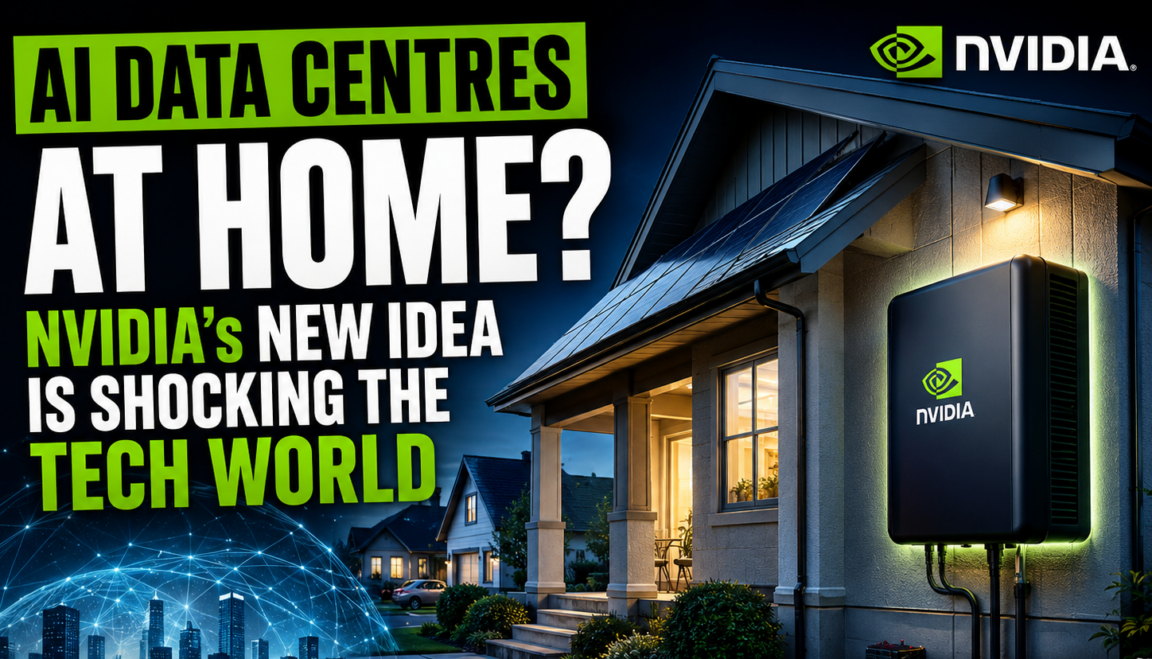
Instead of building more giant facilities, the company is exploring a future where AI data centres operate directly from residential homes.
Nvidia and Span Are Testing AI Data Centres at Home
Nvidia has partnered with California energy startup Span to pilot a radically different infrastructure model. The concept is surprisingly straightforward.
Most modern homes in the United States are built with 200-amp electrical systems. Average household usage rarely comes close to that ceiling. Nvidia and Span believe that unused capacity could comfortably support compact AI computing units installed directly onto residential properties.
These are not noisy server racks bolted to a wall. The systems are reportedly designed as liquid-cooled, fanless units that mount externally and operate quietly in the background.
The goal is to create a distributed AI network powered by thousands of ordinary homes rather than a handful of massive data centre buildings.
That fundamentally changes the infrastructure equation.
Why AI Infrastructure Is Reaching Breaking Point
The AI boom has triggered one of the largest infrastructure races in modern technology history.
Companies including Nvidia, Microsoft, OpenAI, Google and Meta are pouring billions into AI computing capacity. GPU demand has exploded. Cloud processing requirements are accelerating at a pace most energy grids were never designed to handle.
At the same time, building new data centres has become increasingly difficult because of electricity shortages, rising land costs, environmental regulation, local community resistance and construction timelines stretching into years.
Some data centre projects face political opposition because residents fear higher energy bills and grid instability. Others are stalled for years before a single brick is laid.
This is exactly why AI data centres at home are attracting serious attention.
Instead of concentrating enormous power loads into one location, companies could distribute workloads across thousands of smaller residential nodes connected through software. It is the decentralisation of AI infrastructure at scale.
What Homeowners Could Receive in Return
The reason this story is going viral is simple: the incentives for homeowners are significant.
Participating households could receive reduced electricity bills, free broadband internet access, subsidised home energy upgrades and long-term financial compensation for supporting distributed AI computing.
For families facing rising energy costs, that offer becomes genuinely compelling.
The parallel to early solar adoption is obvious. Rooftop solar panels once seemed futuristic and impractical. Today they cover suburban homes across the world. Nvidia and Span appear to believe AI infrastructure could follow the same trajectory.
Span has already conducted prototype testing with paying customers. The next phase involves 100 new construction homes across the southwestern United States launching this autumn. The long-term target is one gigawatt of distributed capacity.
That is no longer a concept. That is a deployment plan.
Could This Replace Traditional Data Centres?
Not entirely. Hyperscale AI facilities will remain essential for the most demanding computing workloads.
But residential AI nodes could meaningfully reduce strain on centralised infrastructure while improving regional efficiency. The model is particularly well suited to edge AI computing, distributed cloud processing, smart city infrastructure and low-latency AI services.
It also scales faster than traditional construction. Instead of waiting five years to permit and build a facility, companies could deploy residential units across entire regions within months.
In an industry where speed of deployment is a genuine competitive advantage, that matters enormously.
The Risks Nobody Should Ignore
Despite the excitement, serious concerns are already being raised.
Grid stability is the most immediate issue. Extreme weather events have repeatedly exposed vulnerabilities in residential power systems. Adding AI computing loads to homes during heatwaves, storms or energy shortages could create dangerous pressure on infrastructure that was never designed for this purpose.
Cybersecurity is another significant challenge. If homes become nodes in a commercial AI network, the attack surface for hackers expands dramatically. Companies will need robust protections to safeguard both systems and personal data.
Regulatory questions also remain unresolved. Governments may eventually introduce entirely new frameworks governing residential computing infrastructure, energy sharing agreements and AI deployment inside residential neighborhoods.
The concept is innovative. Scaling it safely is another matter entirely.
Why This Could Define AI Infrastructure in 2026
Despite the challenges, the timing makes strategic sense.
AI demand is accelerating faster than conventional infrastructure can respond. Nvidia understands this better than almost any organisation on the planet because its chips power the majority of the current AI revolution.
The company is no longer simply selling hardware. It is actively shaping the architecture of how artificial intelligence will operate in the future.
That is why the idea of AI data centres at home carries real weight.
It represents a fundamentally different vision for AI infrastructure. More distributed. More localised. More deeply integrated into everyday energy systems. More connected to the neighborhoods where people actually live.
If this model proves viable, communities themselves could become active participants in the global AI economy rather than passive bystanders fighting data centre construction nearby.
Final Thoughts
A few years ago, the idea of turning homes into AI infrastructure would have sounded absurd.
Today, it is being seriously tested with real homes, real customers and real deployment targets.
Nvidia and Span’s residential data centre concept reflects how rapidly the AI industry is being forced to evolve under pressure from energy constraints, infrastructure bottlenecks and growing public resistance to traditional server farms.
Whether this becomes a mainstream model or remains a bold experiment, one thing is already clear.
The future of AI infrastructure may no longer live exclusively inside giant warehouses.
It may live right next door.
FAQs
What are AI data centres at home? AI data centres at home are compact computing units installed on residential properties that process AI workloads using unused household electrical capacity.
Why is Nvidia exploring residential AI infrastructure? Traditional data centre construction faces energy shortages, land costs, environmental pressure and years-long construction delays. Distributed residential infrastructure offers a faster, more flexible alternative.
What could homeowners receive in exchange? Potential benefits include reduced electricity bills, free internet access, home energy upgrades and financial incentives for supporting distributed AI computing.
Are AI data centres at home safe? The model is still experimental. Key concerns include grid stability during extreme weather, cybersecurity risks and the need for new regulatory frameworks.
Could this become widespread in the future? If the technology proves efficient and economically viable, residential AI infrastructure could scale significantly over the next decade.
Souces-https://moneywise.com/news/top-stories/nvidia-span-xfra-homes-mini-data-centers
Want more future-focused stories on AI infrastructure, smart cities, energy innovation and next-generation real estate trends?
Explore the latest insights at Estate Innovation where technology, property and the future of living connect.