



A building’s exterior is in a constant fight against the environment. Pollution, biological growth, rain, and UV radiation work together to stain, degrade, and discolour facades over time. Maintenance cycles are expensive, disruptive, and in many cases environmentally damaging. Titanium dioxide nanotechnology is offering a different approach to surfaces that clean themselves using nothing more than daylight and rain. In 2025, this is no longer a laboratory concept. It is being specified on commercial buildings, residential developments, and public infrastructure worldwide.
Spending too much on facade maintenance?
Discover how next-generation coatings can cut your cleaning cycles and long-term costs. Explore our Building Maintenance guides at estateinnovation.com
How Titanium Dioxide Nanotechnology Actually Works
Titanium dioxide (TiO2) is a naturally occurring mineral widely used as a white pigment in paints and sunscreens. At the nanoscale, it gains a property that changes everything for building applications: photocatalytic activity.
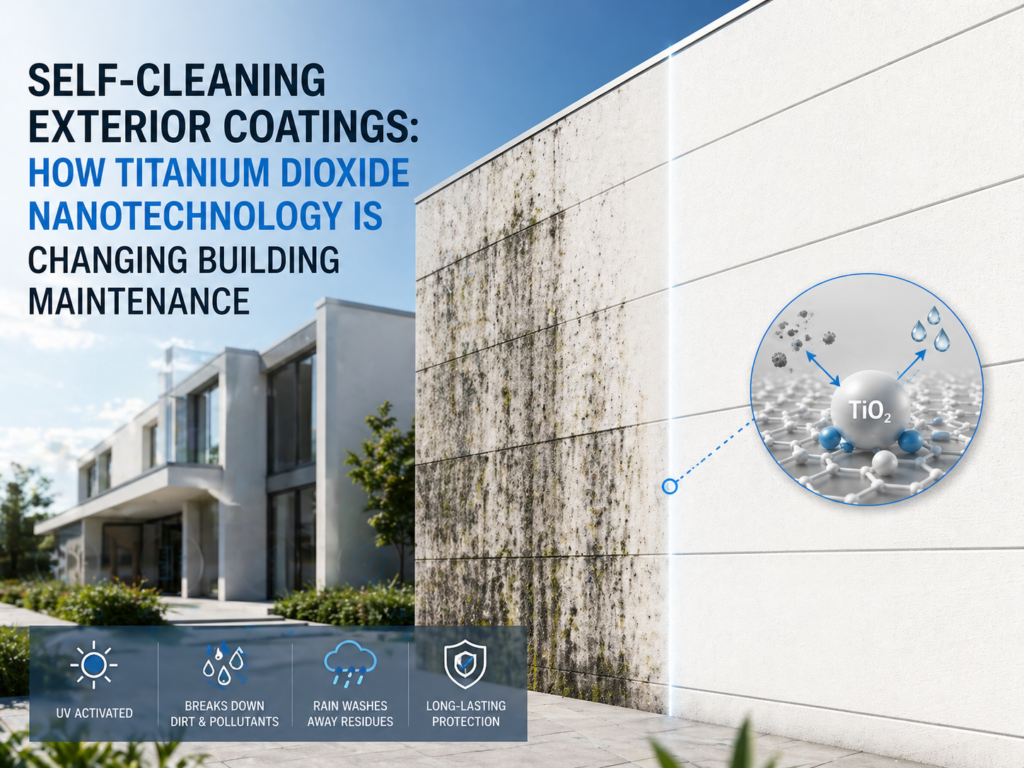
When TiO2 nanoparticles are exposed to ultraviolet light — present in ordinary daylight even on overcast days — they generate reactive oxygen species that break down organic matter on contact. Dirt, mould, algae, bacteria, and airborne pollutants are oxidised and loosened from the surface at a molecular level. When rain arrives, water spreads across the treated surface in a thin, even sheet rather than forming droplets, washing the broken-down residue cleanly away. This dual mechanism — photocatalysis combined with superhydrophilicity — is what makes TiO2-coated surfaces genuinely self-cleaning rather than merely water-repellent.
The coatings are applied as a transparent or lightly pigmented layer over existing renders, concrete, glass, ceramic, and metal substrates. Once cured, the nanoparticle layer is durable, breathable, and invisible to the naked eye.
From Japan to Global Infrastructure: A Technology That Has Proven Itself
TiO2 photocatalytic coatings are not new in principle — Japanese researchers pioneered the technology in the 1990s and the first commercial applications appeared on glass and ceramic tiles in the early 2000s. What has changed is the breadth of application, the durability of formulations, and the cost of deployment at scale.
The Jubilee Church in Rome, completed in 2003, remains one of the most cited early examples — its white concrete facade treated with TX Active cement by Italcementi, which demonstrated measurable NOx reduction in the surrounding air alongside maintained surface brightness. Since then, TiO2 coatings have been applied to hospital facades in Scandinavia, metro station exteriors across East Asia, social housing blocks in France, and commercial tower cladding in the Middle East.
In the UK, several local authorities have trialled TiO2-coated road surfaces and tunnel walls to reduce nitrogen oxide concentrations in high-traffic areas. The air-purifying dimension of the technology — one square metre of treated surface can neutralise the NOx output of a car travelling several kilometres — has made it attractive beyond pure maintenance savings.
Key Applications in Residential and Commercial Buildings
- Rendered and plastered exterior walls on new builds and retrofits
- Concrete and precast panel facades on commercial and mixed-use developments
- Glass curtain walls on high-rise buildings where manual cleaning is hazardous and costly
- Roof tiles and cladding panels in high-pollution or high-humidity environments
- Tunnel linings, underpasses, and covered walkways where biological growth accumulates rapidly
- Historic masonry and heritage stone where chemical cleaning would cause damage
What the Maintenance Numbers Actually Look Like
The financial case for TiO2 coatings rests on reducing the frequency and cost of external cleaning, repainting, and biological treatment cycles. Traditional facade maintenance on a mid-size commercial building typically runs every three to five years depending on location, pollution exposure, and material. Operators using photocatalytic coatings report extending those cycles to eight to twelve years in comparable conditions.
The upfront cost premium over standard masonry paint or render sealer sits at roughly 15–35% depending on product and application method. Against a backdrop of scaffold hire, cleaning contracts, traffic management, and repainting costs, the return on investment calculation tends to be favourable within the first full maintenance cycle — particularly for buildings in urban pollution corridors or coastal environments where biological growth is aggressive.
Limitations and What Specifiers Should Watch For
TiO2 coatings perform best where UV exposure is consistent and rainfall is sufficient to complete the wash cycle. In heavily shaded facades, north-facing elevations in northern latitudes, or very arid climates where rain is rare, the self-cleaning mechanism is significantly reduced. Some formulations require a UV intensity threshold that standard indoor or deeply recessed surfaces cannot reliably reach.
Durability varies considerably between product lines. Cheaper formulations can suffer nanoparticle leaching over time, reducing efficacy. Specifiers should look for independently tested products with documented photocatalytic activity after accelerated weathering cycles — ISO 22197 compliance is the relevant benchmark. Application quality also matters: an uneven or porous substrate will compromise coating adhesion and reduce performance life.
The Road Ahead: Integration and Intelligence
The next development frontier for TiO2 coatings is integration with other functional nano-layers. Research groups in South Korea, Germany, and the Netherlands are developing combined coatings that deliver photocatalytic self-cleaning alongside thermal regulation, anti-icing properties, and even photovoltaic energy harvesting from the same surface treatment. Early commercial products combining self-cleaning and cool-roof functionality are already reaching the market.
Regulatory tailwinds are also building. The EU’s Construction Products Regulation revision and evolving BREEAM and LEED credits for reduced maintenance and improved air quality are beginning to recognise photocatalytic surfaces as a measurable contributor to sustainable building performance. As assessment frameworks catch up with the technology, specification rates will accelerate.
Self-cleaning exterior coatings using titanium dioxide nanotechnology solve a real and recurring problem in building maintenance — they just do it at a molecular level that most building owners never see. The performance case is proven, the commercial case is increasingly straightforward, and the regulatory environment is moving in the right direction. For developers, facilities managers, and architects specifying facades that need to perform over decades with minimal intervention, TiO2 coatings deserve serious consideration on every project brief.
CITATIONS & SOURCES
- Italcementi Group — TX Active Photocatalytic Cement, Product and Research Documentation, 2023. italcementi.com
- ISO 22197-1 — Fine Ceramics: Test Method for Air-Purification Performance of Photocatalytic Materials, International Organization for Standardization, 2016.
- European Commission — Construction Products Regulation Revision Impact Assessment, 2024. ec.europa.eu

