



For decades, commercial architecture followed a familiar trinity: aesthetics, efficiency, and cost per square foot. Glass towers symbolized transparency. Open-plan offices signaled innovation. Sustainability certifications became shorthand for future readiness.
That era is over.
By 2026, architecture is being reshaped by a far more urgent priority: defense.
Not defense in the military sense, but defense as operational survival. Climate volatility, power grid instability, physical security risks, and infrastructure failure are no longer edge cases. They are baseline conditions. In this environment, buildings cannot remain passive structures. They must function as resilient, intelligent systems.
This shift has given rise to a new architectural mindset: ARCH-SHIELD™.
Table of Contents
Key Takeaways: The Shift to Defense-First Design
- The Market Shift: Commercial real estate is moving from aesthetic-first design to defense-first architecture to manage climate, energy, and security risk.
- The Framework: ARCH-SHIELD™ applies defense-system logic—layering, redundancy, and early detection—to civilian buildings.
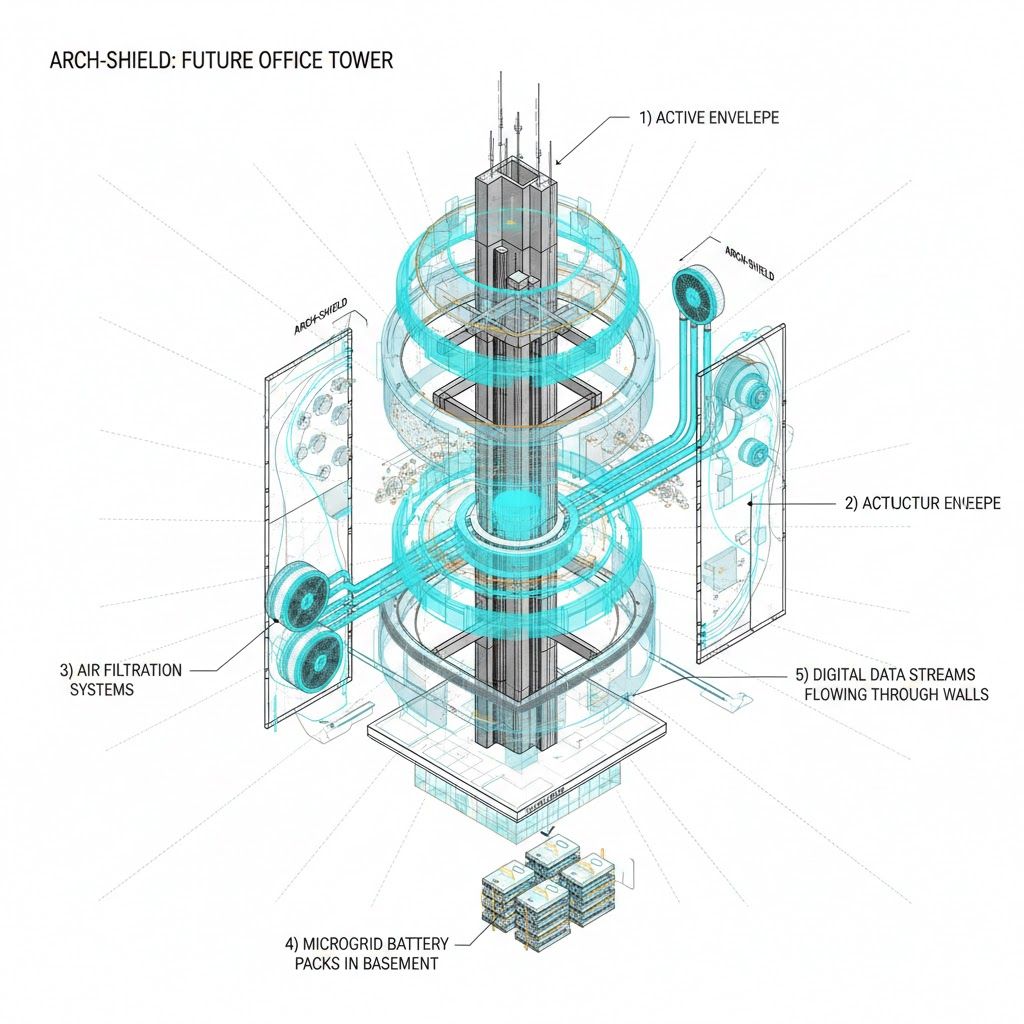
- The Model: Five integrated layers protect structure, envelope, air, energy, and intelligence.
- The ROI Reality: Investors now prioritize survivability, uptime, and lifecycle resilience over surface-level sustainability.
From Iconic Buildings to Protected Assets
Across the US, UK, and Europe, developers and asset owners are no longer asking how buildings look. They are asking how buildings perform under pressure.
Will this building stay operational during extreme heat or flooding?
Can it function through a grid outage?
How fast can it recover from disruption?
What is the real cost of maintenance over 30 years—not just construction?
These questions are pushing architects toward a discipline that has always planned for uncertainty: defense systems design.
Defense strategy assumes failure will occur. It designs for continuity anyway. ARCH-SHIELD™ brings that thinking into commercial architecture, transforming buildings from visual statements into protected operational assets.
ARCH-SHIELD™ vs. Traditional Architecture
| Feature | Traditional Architecture (2010s) | ARCH-SHIELD™ Defense Design (2026) |
|---|---|---|
| Primary Objective | Aesthetics and efficiency | Survivability and continuity |
| Facade Philosophy | Maximum transparency | Controlled exposure |
| Maintenance Model | Reactive | Predictive and data-driven |
| Energy Strategy | Grid-dependent | Grid-independent |
| Value Metric | Certifications and awards | Uptime, risk reduction, asset longevity |
This is not an aesthetic evolution. It is a risk-management revolution.
What Is ARCH-SHIELD™? The 5-Layer Defense Framework
ARCH-SHIELD™ is a defense-first architectural system that integrates materials, technology, and intelligence into a single resilience strategy.
Think of it as cybersecurity architecture applied to physical buildings.
Layer 1: Structural Immunity
Resilience begins at the core. This layer focuses on materials engineered to withstand stress, shock, and long-term degradation.
High-performance concrete, reinforced composite steel, and fire-treated mass timber are selected not just for compliance, but for durability under extreme conditions. The objective is not to delay failure—but to prevent it outright.
For investors, this reframes cost from upfront spend to asset survivability.
Layer 2: Envelope Defense
The building envelope has become the first line of defense.
Modern facades now regulate heat, limit exposure, resist impact, and slow fire propagation. Impact-rated glazing, adaptive shading systems, and fire-resistant cladding replace the all-glass mindset of the past decade.
The shift is subtle but decisive: from openness to controlled exposure.
Layer 3: Environmental Control
A building that stands but cannot be occupied has still failed.
ARCH-SHIELD™ treats air quality, filtration, and internal zoning as defense infrastructure. Advanced HVAC systems enable compartmentalization, high-grade filtration, and intelligent airflow control.
In crisis scenarios—environmental or otherwise—this layer determines whether a building remains operational or becomes unusable.
Layer 4: Energy and Continuity Shield
Defense-first architecture assumes grid instability is normal, not exceptional.
On-site microgrids, battery storage systems, and redundant power routing allow buildings to operate independently during outages. This is no longer a sustainability upgrade. It is a continuity mandate.
Downtime now carries financial, legal, and reputational consequences.
Layer 5: Intelligence and Predictive Maintenance
This is where architecture becomes truly intelligent.
Embedded sensors, structural monitoring, and digital twins allow buildings to detect stress, fatigue, and inefficiencies before failure occurs. Maintenance shifts from reactive repairs to predictive intervention.
In defense terms, this is early-warning capability.
In business terms, it is risk management at scale.
[Visual Placement: Diagram showing the five ARCH-SHIELD™ layers]
Why ARCH-SHIELD™ Is Gaining Traction Now
This framework aligns perfectly with the forces shaping global construction in 2026:
- Governments are funding resilient infrastructure at unprecedented levels.
- Climate events are escalating faster than building lifecycles.
- Investors are pricing operational risk into asset valuation.
- Tenants expect safety, reliability, and continuity.
- Cities increasingly treat buildings as components of national resilience.
Architecture has become strategic infrastructure.
The Bottom Line
The next generation of commercial buildings will not compete on design alone. They will compete on resilience, adaptability, and intelligence.
ARCH-SHIELD™ does not argue for fortress-like buildings. It argues for buildings that think like defense systems—anticipating risk, absorbing shocks, and maintaining control under pressure.
In a volatile world, defended buildings outperform iconic ones.
Those that adapt will define the future of architecture.
Those that do not will quietly become obsolete.source
Frequently Asked Questions
What is the difference between sustainable and resilient architecture?
Sustainable architecture reduces environmental impact. Resilient architecture ensures a building continues operating during disruptions such as extreme weather or power failure.
Does defense-first architecture compromise design aesthetics?
No. Defense is embedded in materials and systems, allowing buildings to remain visually modern while being operationally hardened.
Is ARCH-SHIELD™ more expensive?
Initial costs may be slightly higher, but lifecycle costs are typically lower due to reduced maintenance, fewer failures, and minimized downtime.
Follow Estate Innovation for more insights on sustainable architecture, smart cities, and next-gen construction trends shaping the future of real estate.

